RESOURCES

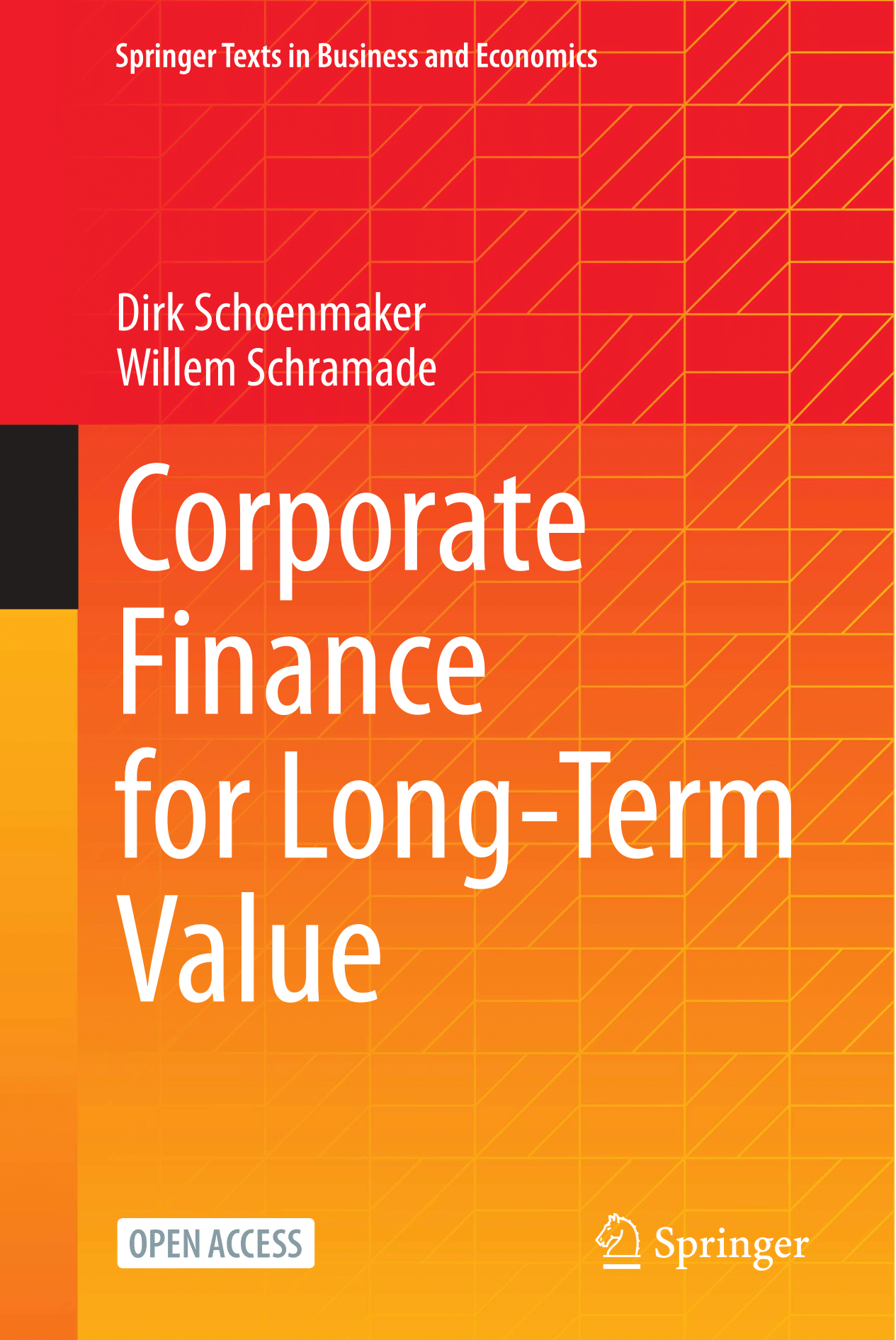
Corporate Finance for Long-Term Value

Corporate Finance for Long-Term Value addresses companies’ core challenge—finding the right balance between profit and societal impact. The book shows that by quantifying and valuing impacts, different impacts can be compared, and trade-offs can be made, allowing organisations to make societal impact a key priority in boardrooms. Inspired by IWAF, the book translates the general concept of sustainability into core corporate finance methods, such as net present value, company valuation, cost of capital, capital structure and M&A. It provides students and professionals with critical instruments for reporting and managing impacts for contributing to the well-being of all people in society. 

Impact-Weighted Accounts Framework 

IWAF is regularly mentioned in the book, and the instruments build further on the key principles of the framework. This book, therefore, brings impact accounting to the lecture halls, educating a new generation of impact professionals! 

Drawing inspiration from recent academic literature and the United Nations’ Sustainable Development Goals, this book offers a comprehensive framework for sustainable corporate finance, guiding businesses, students and professionals toward an impact-driven economy.

Key findings

The report shows that the 20 companies analysed generate substantial positive value for society, but also significant unpriced costs. Their total annual positive contributions amount to approximately €427 billion.  These benefits include customer value, employee well-being and financial returns to investors.

At the same time:

  • Climate-related costs alone absorb 60% of companies’ reported profits
  • When social and environmental costs are fully accounted for, combined profits of €209 billion turn into a net societal loss of €19 billion
  • For every euro of revenue generated, companies create €0.16 in social and environmental costs that are not reflected in profits

These findings underline a deeper structural problem: Europe’s current economic model still depends heavily on business models that shift costs to society, while disadvantaging companies that invest in future-proof alternatives. The report makes a broader case for redefining competitiveness itself. Long-term competitiveness will come from building markets in which the most impactful businesses are also the most competitive.


About the True Profits Assessment

The True Profits Assessment was developed by the Impact Economy Foundation in collaboration with Singapore Management University and Impact Institute. It analyses the 20 largest European companies by market capitalisation and calculates each company’s True Profit: financial earnings adjusted for quantified social and environmental costs and benefits.

The methodology builds on the Impact Weighted Accounts Framework (IWAF) and covers impacts including climate, air quality, biodiversity, material use, employee well-being and consumer value.

More resources

Instrument
Policy Paper
Publication
In Practice
Prev 1 2 3 Next
Prev 1 2 3 Next
Prev 1 2 Next