
Monetary valuation of business impacts is the language business understands, it enables comparability, it incorporates the local context and the complexity of how impacts arise and is relatively easily integrated into traditional accounting systems and decision making. We call on policy makers, standard setters, and other actors to integrate the concept of monetary impact valuation in the relevant processes and frameworks.
RESOURCES
The case for monetary valuation
More resources

Instrument
Policy Paper
Publication
In Practice
Instrument, Publication
From Transparency To Transformation: Unlocking the full potential of CSRD through impact accounting
The Impact Economy Foundation (IEF) introduces the Impact-Weighted Accounts Framework (IWAF) as a transformative tool for organisations already on the path to CSRD compliance. This paper explores the parallels between the Corporate Sustainabili...
Instrument
How the Integrated Value Model enriches corporate decision-making and promotes sustainable business
Organisations and their management need an interpretation of ‘value’ far broader than simple financial value if they want their business to thrive – or even survive – in a world tested by environmental and societal shifts. The decision in where and h...
Instrument, Publication
Impact Management with the Impact Valuation Model (IVM)
In response to the need for businesses to prioritize social and environmental impacts alongside financial gains, the Rotterdam School of Management (RSM) and the Impact Institute developed the Integrated Value Model (IVM) based on the Impact-Weighted...
Instrument
Impact-Weighted Accounts Framework – document
Impact-Weighted Accounts – or IWAs – are a way for organisations to quantitatively assess their impact: how they create value to all stakeholders. The uptake of compiling and publishing IWAs is a key step in the transformation of our economy into an ...
Instrument
Leveraging Corporate Sustainability Reporting For Circular Transformation
This white paper—Leveraging corporate sustainability reporting for circular transformation: A starter guide—shares insights from the latest research endeavour by the Coalition Circular Accounting (CCA). The Coalition assessed the implications of Euro...
Instrument
True cost accounting applications for agrifood systems policymakers
This background paper of the Impact Economy Foundation and True Price Foundation to the Flagship The State of Food and Agriculture 2023 of the United Nations Food and Agriculture Organisation (UN FAO) introduces true cost accounting (TCA) as an appro...
Prev
1
2
3
Next

Policy Paper
Vision Paper Impact Economy Foundation
The impact economy is a market economy revolving around the common good. An impact economy is a market economy that provides the values, information and incentives that optimise the common good and enables people to pursue their own preferences, idea...
Instrument, Publication
From Transparency To Transformation: Unlocking the full potential of CSRD through impact accounting
The Impact Economy Foundation (IEF) introduces the Impact-Weighted Accounts Framework (IWAF) as a transformative tool for organisations already on the path to CSRD compliance. This paper explores the parallels between the Corporate Sustainabili...
Publication
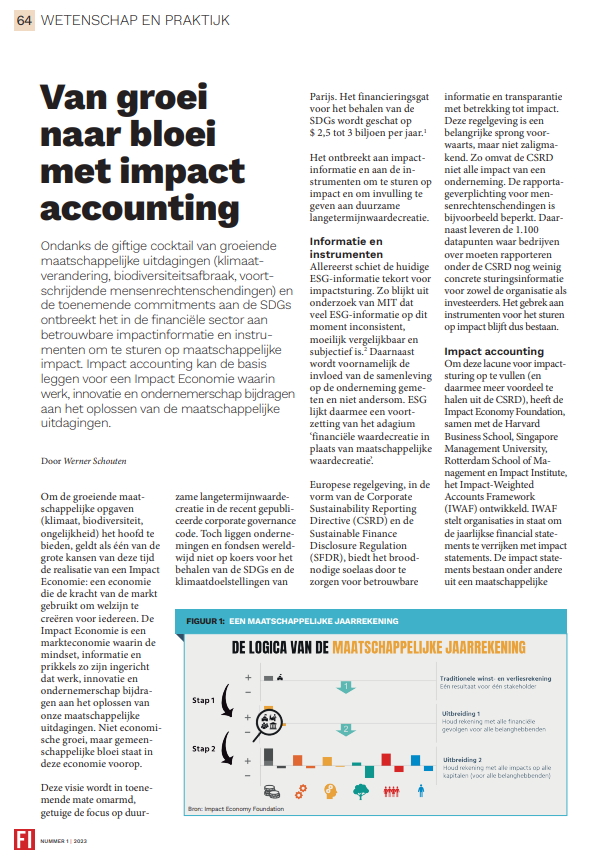
Van Groei naar Bloei met Impact Accounting
Ondanks de giftige cocktail van groeiendemaatschappelijke uitdagingen (klimaatverandering, biodiversiteitsafbraak, voortschrijdende mensenrechtenschendingen) en de toenemende commitments aan de SDGs ontbreekt het in de financiële sector aan betrouwba...

Instrument, Publication
Impact Management with the Impact Valuation Model (IVM)
In response to the need for businesses to prioritize social and environmental impacts alongside financial gains, the Rotterdam School of Management (RSM) and the Impact Institute developed the Integrated Value Model (IVM) based on the Impact-Weighted...

Prev
1
2
3
4
Next


Prev
1
2
Next